In this guide
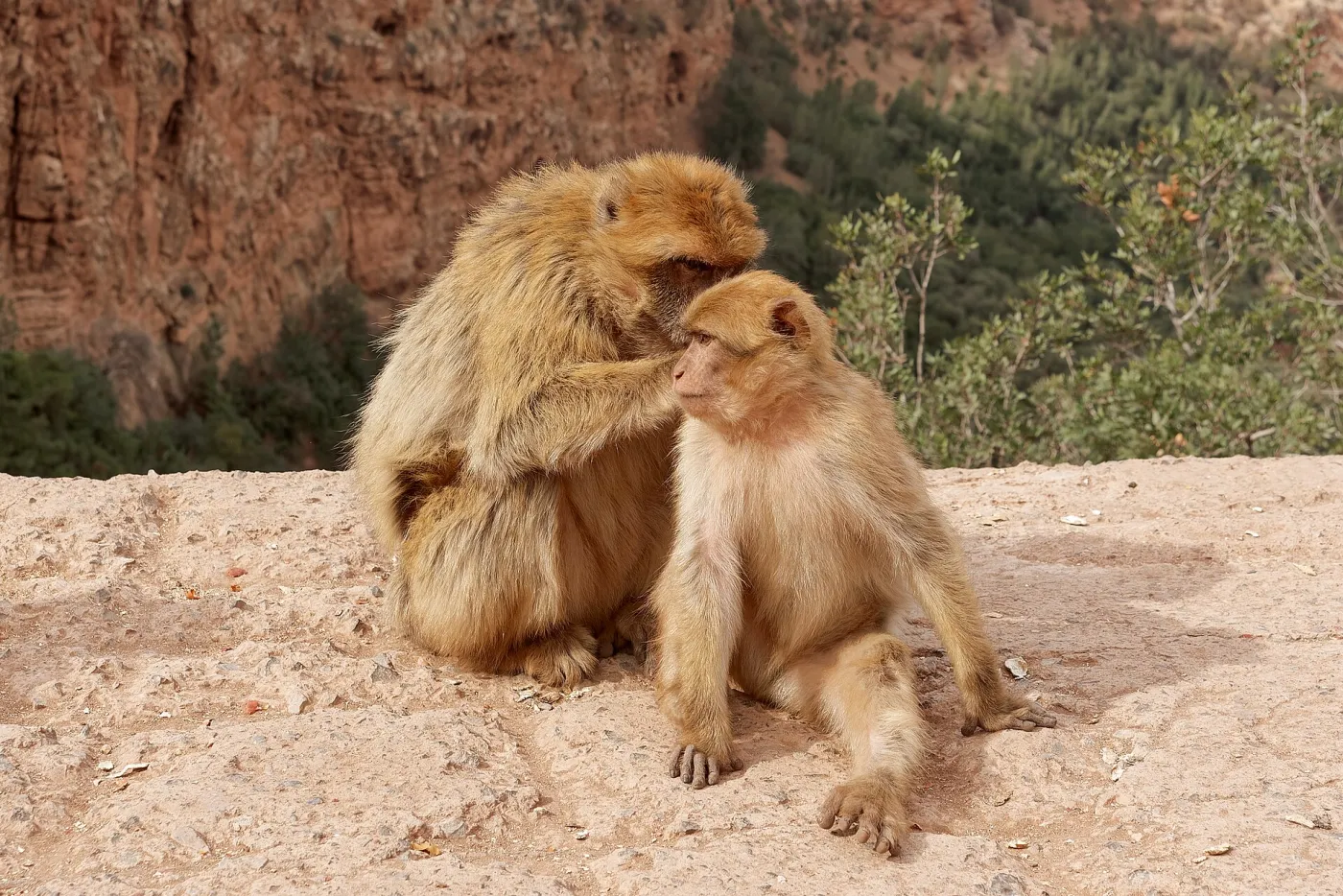
Barbary macaques at Ouzoud live wild in the olive and juniper woods around the waterfalls, about 150 km (2.5–3 hours) from Marrakech, and you will usually meet them on the trails near the lower pools. They are an endangered species, so the responsible way to see them is to keep a couple of metres away, never feed them, and let them approach on their own terms.
Meet the Barbary macaque
The Barbary macaque (Macaca sylvanus) is the only macaque species living outside Asia and the only primate native to North Africa north of the Sahara. It survives in fragmented forests of the Middle and High Atlas and the Rif in Morocco, and in a few spots in Algeria. Since 2008 it has been classified as Endangered by the IUCN, mainly due to habitat loss and the illegal trade in infants sold as pets or photo props. Wild numbers in Morocco are estimated in the low thousands.
At Ouzoud, one or two groups have become used to people. They are sturdy, tailless, with thick fawn fur and expressive pale faces. Adults weigh 10–15 kg, and the young ones cling to their mothers or play in the branches above the path.
Where to find them at the falls
The Cascades d'Ouzoud drop about 110 metres in several tiers into a red-rock gorge. The site is free to enter and the main paths are open all day, while cafés and boat operators work roughly 8:00–18:00. The macaques are most often seen:
- along the shaded path on the left bank, descending from the village towards the base of the falls;
- in the olive trees around the lower terraces and cafés, where they hope for dropped food;
- on the return path on the opposite side, especially in the late morning.
Sightings are not guaranteed, but on most days we see them within the first half hour of walking.
How to see them responsibly
This is the part that matters most, and it is simple.
- Do not feed them. Peanuts, bread and fruit sold by vendors cause tooth decay, obesity and aggression, and teach the monkeys to grab from people. Groups fed by tourists also have higher infant mortality.
- Keep your distance. Two to three metres is a good rule. Let a macaque approach you if it wishes, rather than walking up to it.
- Do not touch or hold them. Bites and scratches happen, and they can pass on infections. Avoid eye contact with large males; a hard stare reads as a threat.
- Put food and drinks away. Close your bag, keep plastic bottles out of sight, and do not eat snacks on the path.
- Skip paid photo sessions with chained or captive monkeys, whether at Ouzoud or in Jemaa el-Fna. Paying for these keeps the trade in wild infants going.
If a macaque jumps onto a bag or table, stay calm, stand up slowly and step back. Do not hit it or pull the item away.
The rest of the Ouzoud visit
Most of the day is really about the waterfalls. Here is roughly what a visit costs in local fees:
| Item | Approx. price |
|---|---|
| Site entry | Free |
| Wooden boat ride to the foot of the falls | 20–30 MAD per person |
| Local guide on the trails | 30 MAD per person in a group; 100–150 MAD private |
| Parking (self-drive) | 10–20 MAD |
| Lunch at a terrace café | 70–150 MAD |
The walk down to the base takes about 20–30 minutes on steps and dirt paths, and the full loop with the return climb takes 1.5–2 hours at an easy pace. Wear shoes with grip; the steps near the water are wet.
Best time to visit
Spring (March–May) brings the strongest flow and green terraces. Summer is hot and busy, but the spray and shade make the gorge pleasant. In late summer and dry years the flow can drop noticeably. Weekdays and early arrival (before 10:00) mean fewer crowds and calmer monkeys.
Photographing macaques well
You do not need to get close for good pictures. A phone at 2x or a camera lens of 70–200 mm lets you frame faces and mothers with babies from a respectful distance. The best light in the gorge is before 10:30, when the sun is low enough to reach the olive trees without harsh shadows. Shoot at the animal's eye level by crouching rather than standing over it, keep flash off, and move slowly. If a macaque turns its back, yawns widely to show its teeth or starts slapping the ground, it is asking you to give it space. A calm, patient ten minutes on a bench usually gives better photos than chasing a group along the path.
Travelling with children
Children love the macaques, which is exactly why a short talk before the walk helps: no feeding, no touching, stay beside an adult. Young kids manage the descent fine, but the steep climb back can be tiring; boat ride and a café break help. For more family ideas, our colleagues' guide to family-friendly things to do in Marrakech is a good companion.
Ouzoud compared with other day trips
Ouzoud is the longest standard day trip we run into the Middle Atlas side, with 5–6 hours of driving in total. If that feels like too much time in the car, the three valleys of the High Atlas offer waterfalls and villages much closer to the city, and Lalla Takerkoust lake is under an hour away for a relaxed swim. You can compare them all on our page of excursions from Marrakech.
Quick FAQ
Are the Barbary macaques at Ouzoud dangerous?
They are not aggressive by nature, but monkeys used to being fed can snatch bags and occasionally bite. Keeping distance and hiding food prevents almost all problems.
Can I feed the monkeys at Ouzoud if vendors sell peanuts?
Please do not. Feeding harms their health and behaviour, even when locals sell food for that purpose.
Are the macaques there all year?
Yes. They live in the surrounding forest year-round and are usually easiest to spot in the morning.
Walk the falls with us
Our Ouzoud cascades excursion with boat ride runs from €32 per person, private or small-group, with free pickup from your riad and a licensed local guide at the falls who follows the no-feeding rule. Send us a WhatsApp or a message through the website with your date; payment is on the day.
Comments