In this guide
Rissani market is the big traditional souk of the Tafilalet oasis, about 35–40 km from Merzouga, held on Sundays, Tuesdays and Thursdays, with the busiest mornings roughly 8 am to 1 pm. Go for the donkey park, dates, spices and livestock, then drive the short ksar route past the ruins of Sijilmassa, the Moulay Ali Cherif mausoleum and old fortified villages.
Why Rissani matters
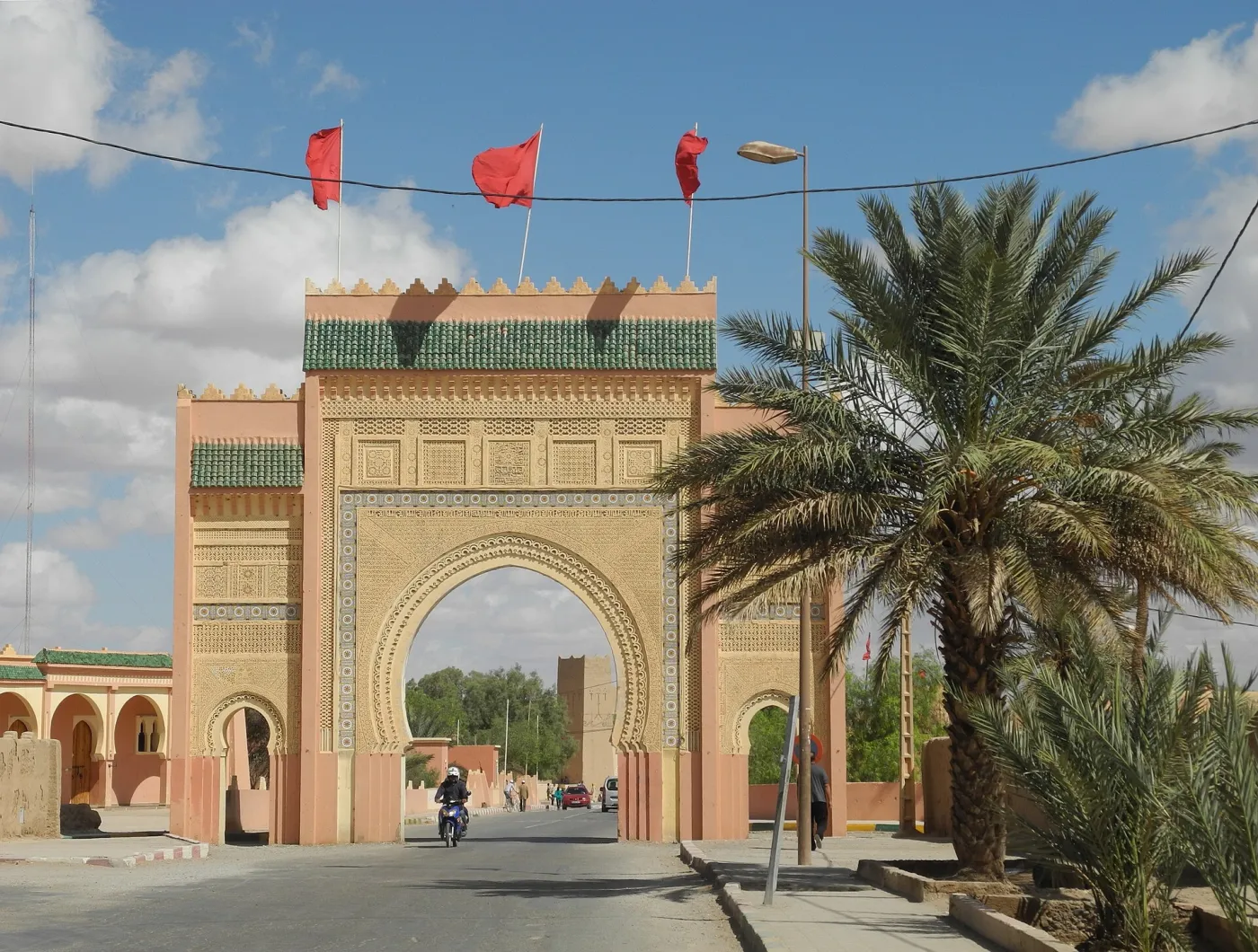
For more than a thousand years, the Tafilalet oasis was where the Sahara met the rest of Morocco. Just outside today's Rissani lie the ruins of Sijilmassa, founded in the 8th century, which grew rich as the northern terminus of the caravan routes across the desert. Gold, salt, slaves, ivory and cloth passed through here on their way between West Africa and the Mediterranean. The city declined centuries ago, but the region kept its importance: the Alaouite dynasty, which still rules Morocco, came from Tafilalet in the 17th century.
Today Rissani is a low, dusty market town of pink mud-brick walls and palm groves. It is the last proper town before the dunes, and most drives to Merzouga pass straight through it.
Rissani market: days and timing
| Day | What to expect |
|---|---|
| Sunday | The main souk day, biggest crowds and the fullest livestock market |
| Tuesday | Busy market day, fewer tourists |
| Thursday | Busy market day, good for photos |
| Other days | Permanent shops and stalls open, but much quieter |
Arrive between about 8 and 11 am. By early afternoon many traders pack up, and in summer the heat is strong after noon. On the way to Merzouga from the Todra Gorge, a market-day morning stop fits in easily.
What you will see in the souk
The donkey park
The famous sight: a large walled lot where people from surrounding villages leave their donkeys for the day, sometimes hundreds of them, tied in rows. A small parking fee is paid to an attendant. It is a working space, so keep clear of back legs and ask before photographing the owners.
Livestock market
Sheep, goats and sometimes camels change hands in a separate area, mostly early in the morning. It is lively and very real; not everyone will enjoy it.
Food, spices and dates
Tafilalet is known for its dates, and Morocco's prized Majhoul (Medjool) variety is historically associated with this oasis. Harvest is around September to October, and a kilo of good dates costs roughly 40–120 MAD (€4–11) depending on variety and quality. You will also find spices, henna, dried fruit, olives, fresh vegetables and piles of fresh bread.
Crafts and practical goods
Turbans (cheches), leather goods, woven baskets, pots, tools and second-hand everything. Prices for visitors are negotiable; a relaxed, smiling back-and-forth works better than hard bargaining.
Madfouna: the dish to try
Madfouna, sometimes called "Berber pizza", is a local specialty: flat bread stuffed with minced meat, onions, egg, spices and sometimes almonds, baked in a wood-fired oven or in hot sand. It is filling and made for sharing. Expect around 60–120 MAD (€6–11) for one, which feeds two people. Many restaurants in Rissani and Merzouga make it to order, so ask your driver to call ahead.
The ksar route: a short loop around Rissani
South of the town, a signposted circuit of roughly 20 km links the main historic sites. Allow 1.5–2.5 hours with stops.
- Sijilmassa ruins: low earth walls and mounds just outside town. There is little to see without a guide, but standing on the site of a city that once traded gold with Timbuktu is moving.
- Mausoleum of Moulay Ali Cherif: the resting place of the founder of the Alaouite line, with green-tiled roofs and a fine courtyard. Non-Muslims can usually visit the outer courtyards but not the tomb chamber; dress modestly.
- Ksar Abbar: a large fortified complex once used by members of the royal family; you can see its high walls and gate.
- Ksar Oulad Abdelhalim: an early 20th-century ksar with decorated gateways, sometimes called the "Alhambra of Tafilalet". Local guides may offer to show you inside for a tip.
- Palm groves and irrigation channels between the ksour, where families still farm dates, alfalfa and vegetables.
A ksar (plural ksour) is a fortified village where several families lived inside one set of walls, distinct from a kasbah, which was usually a single family's fortified house. To see a kasbah still lived in by the family that built it, read our guide to Skoura and Kasbah Amridil.
Connecting Rissani to the rest of the desert
The caravan history explains a lot about the area around Merzouga, including the Gnawa families of Khamlia, whose ancestors came north on these same routes. Our Khamlia and Gnawa music guide tells that story. If you enjoy markets, the Asni Saturday souk near Marrakech is a smaller, mountain version you can visit on a day trip.
Erfoud and the fossils
About 20 km north of Rissani, the town of Erfoud is known for fossils: the black limestone of the region is full of ammonites and orthoceras hundreds of millions of years old, polished into table tops, sinks and souvenirs. Workshops welcome visitors to see the cutting and polishing. Quality and authenticity vary, so buy from a workshop rather than a roadside stall, and in late October Erfoud also holds a date festival.
Practical tips
- Bring small notes and coins; change for 200 MAD notes can be hard to find.
- There are ATMs in Rissani, the last reliable ones before Merzouga.
- Wear a scarf and sunglasses; dust and wind are common in spring.
- Photograph the scene freely, but ask before close portraits.
- Friday is prayer day, and some shops close around midday.
Quick FAQ
How far is Rissani from Merzouga?
About 35–40 km on a good paved road, roughly 35–45 minutes by car.
Is Rissani worth visiting on a non-market day?
Yes, for the ksar route and a madfouna lunch, but the souk itself is much livelier on Sunday, Tuesday or Thursday.
Do I need a guide in Rissani?
Not for the market, but a local guide adds a lot on the ksar route, where the history is not signposted in English.
See Rissani on your way to the dunes
Our 4-day Sahara & Kasbahs Loop from Marrakech (from €260 per person) passes through the Tafilalet on the way to Merzouga, and because it is private, we can time it for a market day and add the ksar route. Pickup from your Marrakech riad is free. Compare it with our other Sahara desert tours, then message us on WhatsApp; there is no online prepayment.
Comments