In this guide
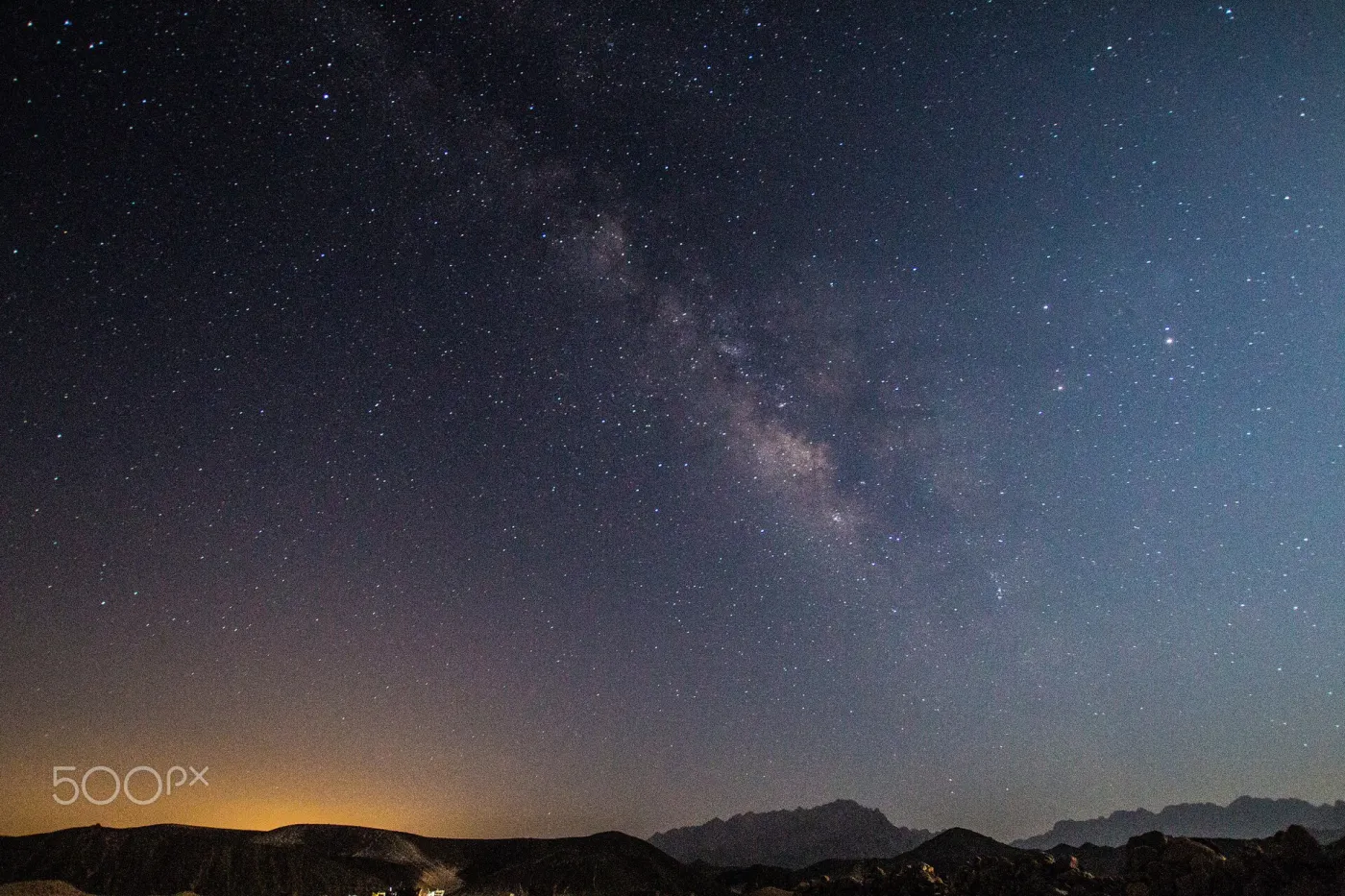
Sahara stargazing is best within about five days either side of a new moon, on a clear night away from camp lights. In Erg Chebbi near Merzouga the sky is dark enough to see the Milky Way with the naked eye; its bright core is highest from roughly April to September, while winter nights are longer, colder and often the clearest.
Why the Sahara sky looks so different
Most of our guests come from cities where they see maybe a few dozen stars. Out in the dunes of Erg Chebbi, the nearest town of any size is Rissani, around 40 km away, and the air is dry most of the year. On a moonless night you will see thousands of stars, the band of the Milky Way, satellites crossing every few minutes and, quite often, a shooting star before you finish your mint tea. Astronomers rate sky darkness on the Bortle scale from 1 (pristine) to 9 (inner city); the deep dunes sit near the dark end, somewhere around 2, while Marrakech is at the bright end.
The one thing that can ruin the show is not clouds but the moon. A full moon lights the dunes so brightly that you can walk without a torch, which is lovely in its own way, but it washes out all but the brightest stars.
Moon phases: the single most important factor
When you plan your dates, check the lunar calendar before anything else. As a rough guide:
- New moon, plus or minus 4–5 days: the best window. The moon is absent or sets early, and the Milky Way is at its most vivid.
- First quarter: the moon sets around midnight, so stars improve a lot in the second half of the night. Fine if you are happy to wake at 2 or 3 am.
- Last quarter: the reverse; dark evenings, then the moon rises after midnight. Good for people who go to bed early.
- Full moon: bright, silver dunes and night walks, but weak stargazing.
Upcoming new moons (dates in European time, so they may shift by a day in Morocco): 10 October 2026, 9 November 2026, 9 December 2026, 7 January 2027, 6 February 2027, 8 March 2027, 7 April 2027, 6 May 2027 and 4 June 2027. If your trip falls close to one of these, you are in luck.
Milky Way season and the best months
The Milky Way is visible all year, but the bright galactic core (the part in all the famous photos) is best seen from about April to September, low in the south in spring and higher overhead through summer evenings. In winter you see the fainter outer arm, with Orion, the Pleiades and Sirius very bright.
| Season | Sky | Night temperature at camp (approx.) |
|---|---|---|
| March–May | Core rises after midnight early in spring, earlier by May; some dusty days | 8–18°C |
| June–August | Core high in the evening; heat haze and occasional sandstorms | 22–30°C |
| September–November | Core visible in the early evening, settled weather | 12–22°C |
| December–February | Very clear, long nights, no core | 0–6°C, sometimes below freezing |
If cold nights put you off, read our guide to the Sahara in winter before deciding; many of our favourite star nights have been in January.
How to get the most out of the night
Walk away from the camp lights
Even a small desert camp has solar lamps along the paths. Walk five to ten minutes up the nearest dune ridge, or ask your camp team to switch off the lights for a while; most are happy to help. Never go far alone in the dark, and note the direction of the camp before you leave.
Give your eyes time
Full dark adaptation takes 20–30 minutes. Avoid your phone screen, or turn it to red mode or minimum brightness. A red head torch is ideal.
Use a free sky app
Apps such as Stellarium or SkySafari help you find planets, constellations and the International Space Station passes. Download offline maps before you leave Marrakech, because mobile signal at camp can be patchy.
Dress as if it were two seasons colder
Sand loses heat fast after sunset. Even in October, a fleece and a hat make lying on the dune much more pleasant. Camps provide blankets, and in winter we bring extra ones.
Camera settings for stars over the dunes
You do not need professional gear. A camera with manual mode, a wide lens and a small tripod will do; recent phones with night mode can also get decent results if you prop them on something steady.
- Mode: manual (M), RAW if you can.
- Lens: as wide as possible (14–24 mm on full frame) and the widest aperture, ideally f/1.8 to f/2.8.
- Shutter: use the "500 rule" as a start: 500 divided by focal length. At 20 mm that is about 25 seconds; drop to 15–20 seconds for sharper stars.
- ISO: 1600–3200 on most modern cameras; go to 6400 only if you have a very clean sensor.
- Focus: switch to manual, zoom in on a bright star or planet in live view and turn the ring until it becomes a tiny point. Tape the ring so it does not move.
- White balance: around 3800–4200 K gives a natural blue-black sky.
- Timer: use a 2-second timer or remote so the camera does not shake.
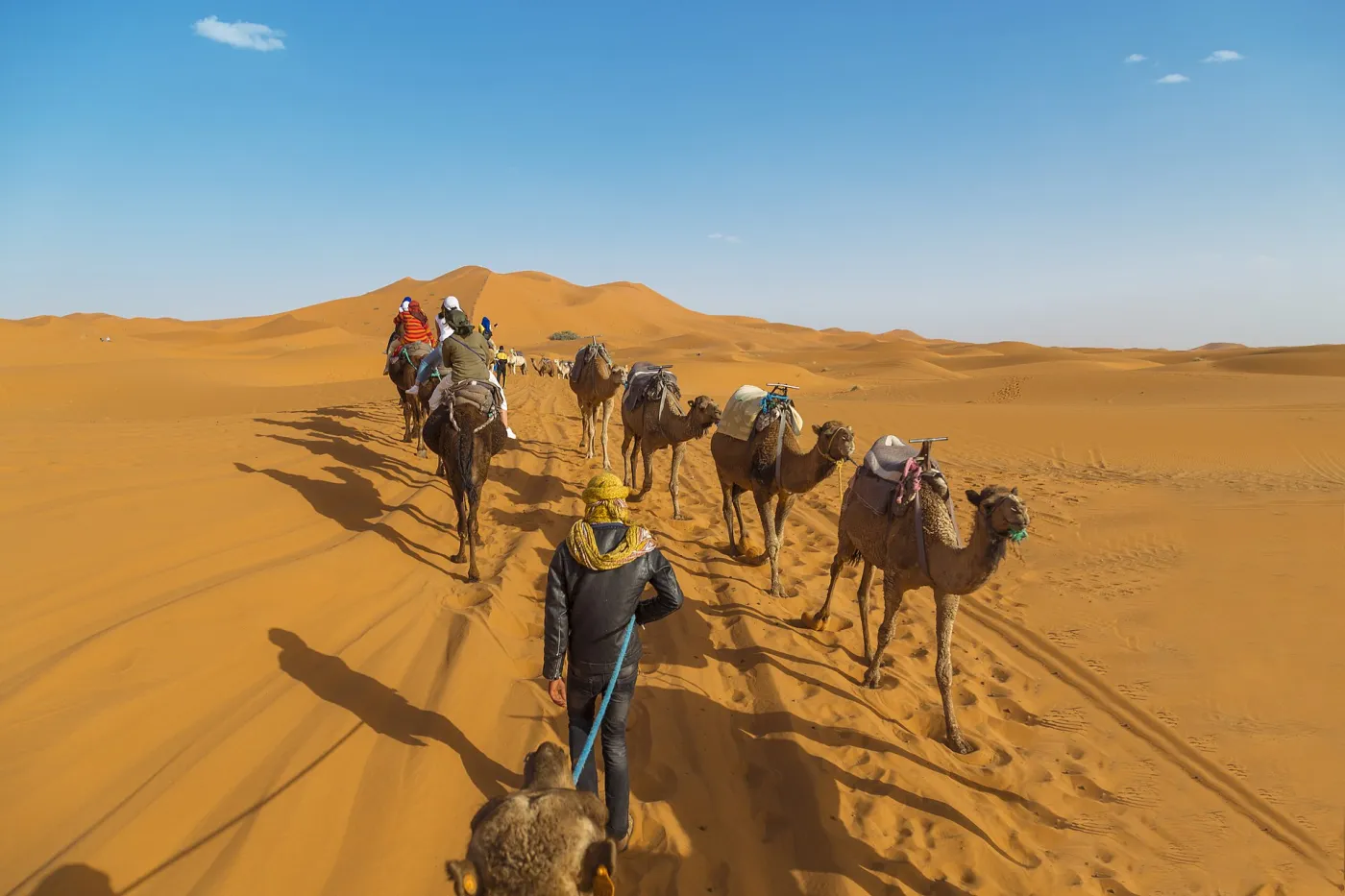
For a foreground, a tent, a camel resting or a friend with a dim lantern on the dune crest works well. Sand gets everywhere, so change lenses inside your tent and keep the camera in a zipped bag during the day. For the golden-hour and caravan shots before dark, our tips in your first camel trek guide will help.
Merzouga or Zagora for stars?
Both are dark, but Erg Chebbi is larger and further from towns, so you can get more distance between yourself and any light. Zagora is closer to Marrakech (around 7 hours by road instead of 9–10) and a good option if you have only two days; the sky there is still far darker than anything in Europe. You can compare all our desert options on our Sahara journeys page.
Quick FAQ
Can I see the Milky Way from a desert camp without a telescope?
Yes. On a moonless, clear night it is plainly visible to the naked eye as a pale band across the sky. Binoculars are a nice extra for star clusters and the moon's craters.
Does a sandstorm ruin stargazing?
Dust in the air dims the stars for a night or two, mostly in spring and early summer. It usually clears quickly; if you have a flexible schedule, a second night in the dunes improves your odds.
Is it safe to walk on the dunes at night?
Yes, with common sense: stay close to camp, take a torch, and tell the team where you are going. Scorpions are rarely seen in the cooler months and stay hidden in the sand.
Plan your night under the stars with us
If you would like to time your trip for a new moon, tell us your dates and we will suggest the best nights. Our private 3-day Merzouga desert tour (from €165 per person) includes a night in an Erg Chebbi camp, free riad pickup in Marrakech and a local driver who knows where to stop for the darkest sky. Send us a message on WhatsApp or through the website; there is no online prepayment, and we are happy to adjust the itinerary around the moon.
Comments